PAC Tip: Memorization
Our Peer Academic Consultants can help with a variety of skills, including memorization. Here are some useful tips on how to effectively memorize information.
What can help me memorize information effectively?
Sleep & Exercise
Getting sufficient sleep is one way you can help your brain memorize information more effectively. While we sleep, our brains process information. This means that a good night’s rest can help you retain the material you study. Being well-rested also improves focus and brain function. Exercise similarly primes your brain for learning and memorization.
What strategies can I try to memorize information?
Understanding the Material
Before trying to memorize material, first work to fully understand it. This will make memorization easier.
Organizing Information: Creating Groups and Making Connections
Information is easier for us to remember when we put it into context. This is why it can be helpful to connect new information with things you already know or topics you are interested in. Additionally, it is easier to remember information when we put it into groups rather than trying to memorize a bunch of separate pieces of information. For example, say you want to memorize the numbers below:
4 8 3 2
7 6 1 2
3 9 5 8
1 2 5 7
Trying to remember 4832, 7612, 3958, and 1257 will yield better results than trying to remember 4, 8, 3, 2, 7, 6, 1, 2, 3, 9, 5, 8, 1, 2, 5, and 7.
One technique you can use to group information is a mnemonic device. A mnemonic device is a phrase, acronym, or short rhyme that chunks and connects information. Well-known examples include:
- My very excellent mother just served us nectarines. The first letter of each word corresponds to one of the planets: Mercury, Venus, Earth, Mars, Jupiter, Saturn, Uranus, Neptune.
- Please excuse my dear Aunt Sally. This mnemonic refers to the order of operations: parentheses, exponents, multiplication/division, and addition/subtraction.
- ROY G BIV This acronym is made up of the colors of the rainbow: red, orange, yellow, green, blue, indigo, violet
Mixing It Up
Interleaving is a technique in which you study multiple subjects during a study session. For example, say you have 2 hours to study. With interleaving, you might spend 40 minutes on English, 40 minutes on History, and 40 minutes on Mandarin instead of spending the full 2 hours on English. This approach can help you remain engaged, leading to more productive studying. Interleaving also supports long-term memory and helps build connections across subjects.
Another way to add variety to study sessions is by using multiple study methods. Mix up the type of review activities you are doing to keep yourself engaged. This will also help build your recall ability.
Repetition
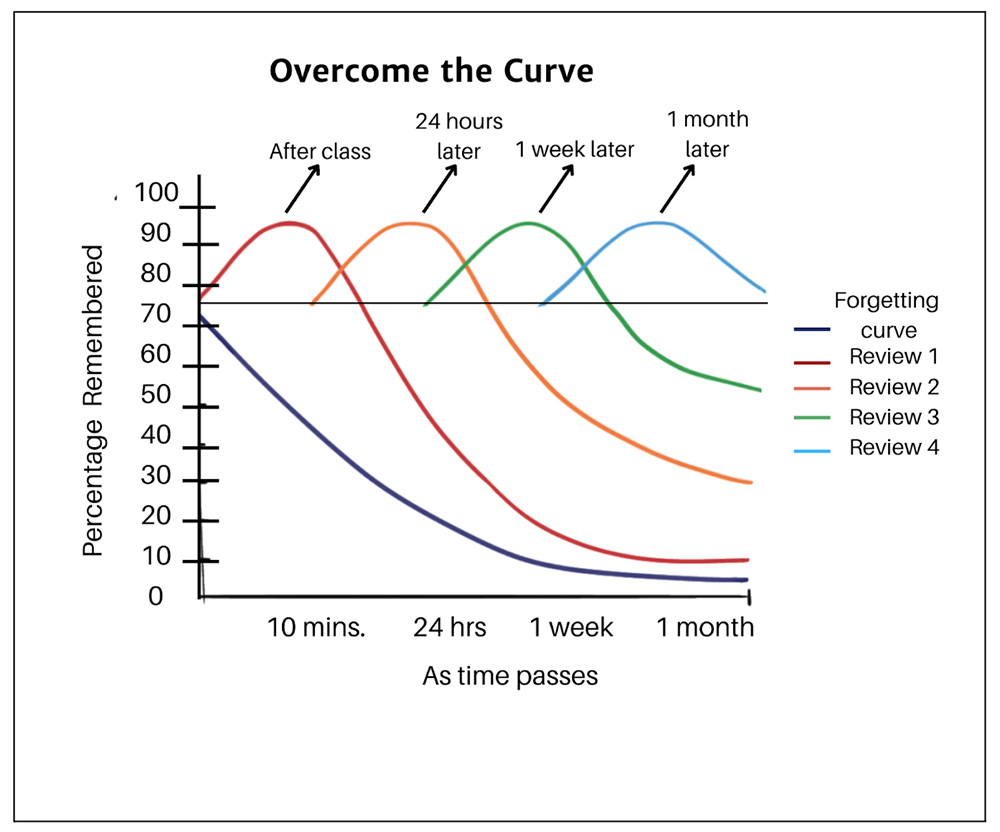
Spacing out studying over time is more effective than cramming in a long study session at the last minute. It is best to have repeated exposure to the material over a long period of time. The following graph from the Barnard Center for Engaged Pedagogy shows how repeated engagement with material can help build your long-term memory. It suggests reviewing the material 10 minutes after class, the day after class, 1 week after class, and 1 month after class in order to retain around 80% of the information. You will notice that the intervals between reviews increase over time as your brain gets better at recalling the information.
Graph explanation
This graph, titled “Overcome the Curve,” shows how memory fades over time and how reviewing material at intervals helps you remember more.
- The horizontal axis (x-axis) shows time passing: 10 minutes, 24 hours, 1 week, and 1 month.
- The vertical axis (y-axis) shows the percentage of information remembered, from 0% to 100%.
Without review
- The dark blue line (“forgetting curve”) shows that memory drops quickly after learning.
- You might remember around 70% right after class, but this falls steeply to very low levels (around 5–10%) after a month.
With review
There are four additional curves (red, orange, green, light blue) showing what happens when you review the material:
- Review 1 (red): Reviewing soon after class boosts memory back up, but it still declines over time.
- Review 2 (orange): Reviewing again about 24 hours later raises memory again and slows the decline.
- Review 3 (green): A third review about a week later keeps memory higher for longer.
- Review 4 (light blue): A fourth review about a month later maintains the highest long-term retention.
Key takeaway
Each time you review the material, your memory is refreshed and fades more slowly. Spacing reviews over time helps you remember much more in the long run compared to not reviewing at all.
Active Recall
Use study techniques that require you to pull information from your memory. For example, flashcards are a form of active recall. On the other hand, matching terms with definitions is passive because all the information is provided for you.
Sensory-Based Strategies
Sensory-based study techniques can make information more memorable.
- Sight
- Visual Representations: create drawings, symbols, graphs, charts, or other visual representations of information.
- Memory Palace: In this technique, you imagine a palace or other building. Then, you associate information with objects in the building. The goal is to be able to walk through the building in your mind and recall the information as you see the different objects.
- Visual Metaphors / Analogies
- Visualization
- Mind Maps: Write down a central idea in the center of your paper. Then, write related ideas around it. Connect them to the central idea with lines. Continue writing and connecting ideas across your paper. See the PAC Notetaking Tip for more information about the mapping method.
- Timelines
- Zines
- Sound
- Songs and Jingles: Create a song or short jingle about the material.
- Talk to Yourself
- Teach Others
- Tactile
- Handwritten Notes: Writing information by hand, as opposed to typing, leads to greater memory retention. This is because handwriting activates more of your brain and involves greater interaction with the material.
Need more help?
Check the Peer Academic Consultants main page for more information on memorization and other academic skills. Our Peer Academic Consultants (PAC) are also available for individual consultations during which we can discuss your academic skills and personalize these strategies to be most effective for you! If you would like to sign up for a one-on-one consultation with a PAC, we invite you to do so online by logging into WCOnline.
References
“Studying for Memory & Comprehension.” Barnard College Center for Engaged Pedagogy, Accessed 24 September 2025.
“Memorization Strategies.” University of North Carolina at Chapel Hill, Accessed 24 September 2025.
“Memorization Techniques.” Ross Education, Accessed 24 September 2025.
“Sleep’s Crucial Role in Preserving Memory.” Yale School of Medicine, 10 May 2022, Accessed 25 September 2025.
Marano, Giuseppe et al. “The Neuroscience Behind Writing: Handwriting vs. Typing-Who Wins the Battle?.” Life (Basel, Switzerland), vol. 15, no. 3, 22 February 2025, pp. 345. Doi:10.3390/life15030345. Accessed 29 October 2025.
Paul, Tanisha. “A Beginner’s Guide to Interleaving.” Washington University in St. Louis, Accessed 10 December 2025.